
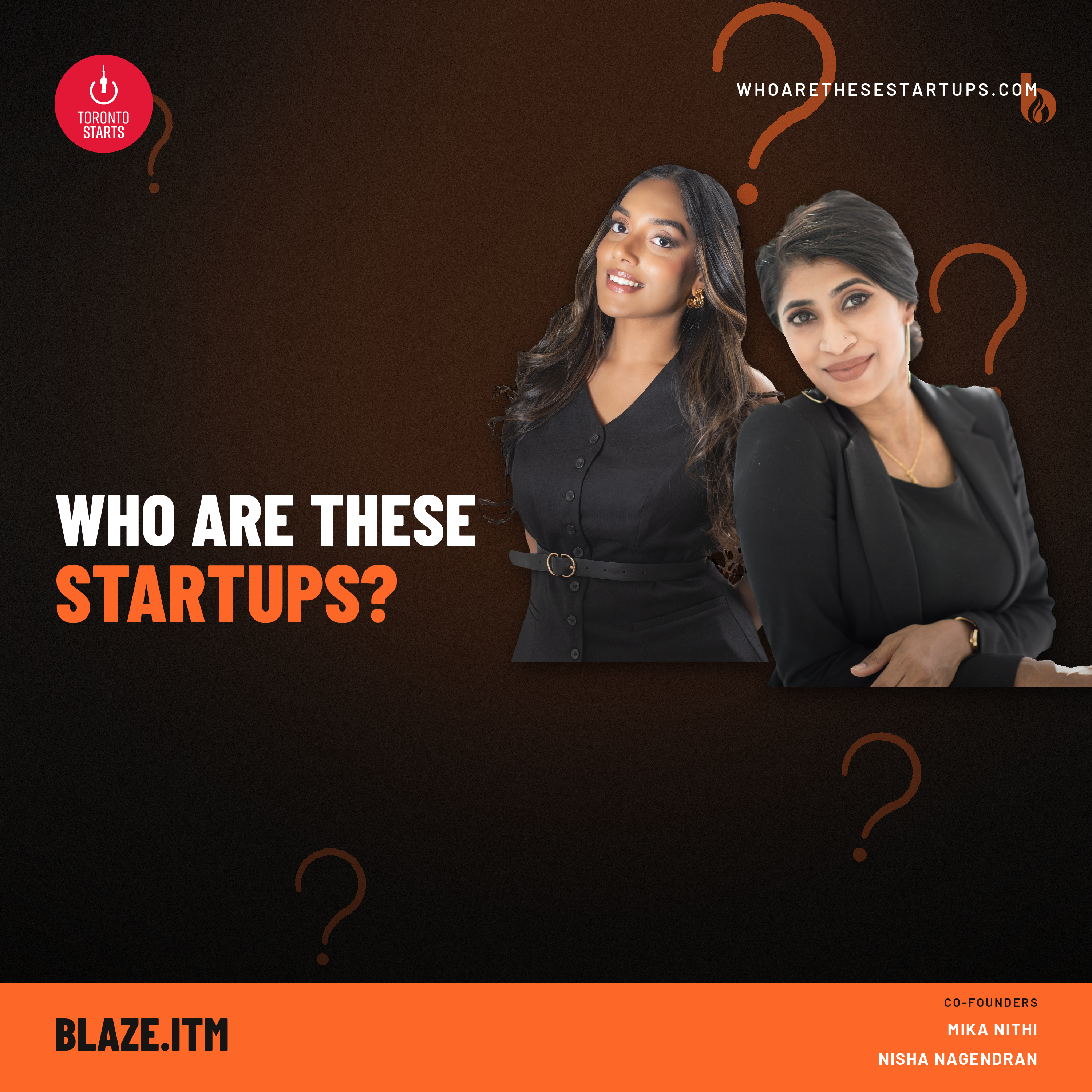
Mika Nithi & Nisha Nagendran of Blaze.ITM: Turning Ice-Time Moments Into Family Memories
In this episode of Who Are These Startups, Craig Major talks with Mika Nithi and Nisha Nagendran, co-founders of Blaze.ITM, about turning ice-time moments into family memories. Mika Nithi and Nisha Nagendran are the co-founders of Blaze.ITM, an Ottawa-based hockey photography company that prints…



Meet Mika Nithi and Nisha Nagendran
Blaze.ITM
Mika Nithi and Nisha Nagendran are the co-founders of Blaze.ITM, an Ottawa-based hockey photography company that prints tournament photos right at the rink. Together they're building Blaze Athlete, an app that keeps a lifelong record of young athletes' sports memories.
In this episode of Who Are These Startups, Craig Major talks with Mika Nithi and Nisha Nagendran, co-founders of Blaze.ITM, about turning ice-time moments into family memories.
Mika Nithi and Nisha Nagendran are the co-founders of Blaze.ITM, an Ottawa-based hockey photography company that prints tournament photos right at the rink. Together they're building Blaze Athlete, an app that keeps a lifelong record of young athletes' sports memories.
In this episode
- How a background in wedding photography led them to on-site photography at minor hockey tournaments
- Why a photograph can become a lifelong memory for a family
- How the photography business and the Blaze Athlete app fit together, including the app's passport section where players and families keep their memories
- What they wish they'd known before starting: the whole operation behind the service, and clear roles from day one
- How a small team uses AI agents, Claude Code and vibe coding to build its own tech
- Why they test on site at tournaments every weekend
- The Canadian startup resources they looked at, including Futurpreneur and Digital Main Street
- Advice for service-business founders building a tech product: understand your service inside out, and own and know your data
Links
[0:09] Craig Major: Welcome back to Who Are These Startups. I'm Craig Major, the startup coach and founder of TorontoStarts. And with me today is Mika and Nisha, co-founders of Blaze.ITM, the Ottawa company that photographs young players at minor hockey tournaments and is now building Blaze Athlete app for players and parents. Welcome.
[0:25] Nisha Nagendran: Hi, thank you for having me.
[0:28] Craig Major: It's great to have both of you here. I love the idea and I'm really interested in finding out the direction and where you're planning on going, but we might as well jump right in with what does Blaze.ITM do?
[0:45] Nisha Nagendran: So yeah, so Blaze.ITM, it's a sports photography business. So we specialize in hockey and youth sports photography. So we basically capture athletes in action, creating professional photographs and that's for the athletes and their families. So these are long lasting memories that they can keep.
[1:08] Mika Nithi: Yeah. So exactly what she was saying. We do photos on site at hockey tournaments and different events. And they're, again, long lasting pieces of photographic print that we sell on site. And parents can take that home with them and they can keep it forever. They have digital of their players from games, all that stuff.
[1:27] Craig Major: So who is Blaze.ITM for both the photography business and the Blaze Athlete?
[1:35] Mika Nithi: Yeah, so Blaze.ITM is honestly for both the parents and the kids as much as it's for the teams. We have athletes from different teams all across Ontario, Canada, United States that fly in for tournaments. And we're basically creating memories, capturing them on the ice. And this is just like moments that live with the teams forever and also with the parents. So there's team photos and individual player posters and all that kind of fun stuff to really document their growth.
[2:04] Craig Major: And what's your startup story from wedding photography to hockey tournaments? How did that happen? And when did you connect on the whole process?
[2:15] Mika Nithi: Yeah, so photography was something that we started a long time ago and transitioning from the wedding space and going into hockey was obviously something that we didn't expect to do. It kind of came upon us. We've been friends for a long time.
[2:30] Nisha Nagendran: We were fortunate enough to meet during the day through photography. Over the years, as you know, I
[2:38] Mika Nithi: Like she's a mom, she has kids. And over the years, as we were able to kind of capture them through their their growth, their moments and all these extracurriculars, it became one of those things where we were like, OK, there has to be more coverage in the sports industry. And it's it's not like it's missing. It is there. it could just be done better. So that's where this idea kind of flourished. Again, being a mom of like young boys and hanging out with them a lot.
It's just that you see all these sports happening and parents are so invested in it and the amount of time that they put into it, it becomes their whole life. And that's where we were just like, okay, there's there's a buying market here for sure. How do we optimize it? And how do we give them a product that looks really, really great coming from that professional industry experience with the wedding space, right? Because of the high end finishes, the luxury products, like how do we bring that into the sports industry?
[3:31] Craig Major: So yeah. So I like to say that only an entrepreneur will work eighty hours to avoid working forty. What drives both of you as an entrepreneur?
[3:39] Nisha Nagendran: well so basically you know this is just It gives us the opportunity to build something meaningful and then see it grow as well because we're working with so many kids you know the sometimes the the the excitement that we see the parents looks on their faces proud moments right capturing that for them is really special so we love the idea that a photograph can become a lifelong memory for a family Again like I said they are in action and I don't know if you got a chance to kind of see how we take those photos or or it's like but a child might look back years later at a hockey photograph and remember the the team they played for the tournament they attended for the season and that they worked so hard because hockey is something that they put their blood, sweat, and heart into.
So from a business perspective, we're motivated by growth. We want to build a strong relationship. We want to improve the experience we provide, whether it's through how we do it, the technology, and what we see or think we want, sorry, that we think parents want to see. So we enjoy the challenges. You know, there's always something new to learn and improve and develop. So that's pretty much what drives us. And every weekend we go in and there's always something new that we learn.
We bring back and change it as soon as the next weekend.
[5:16] Craig Major: And how would you define success? What would success look like for Blaze Athlete?
[5:22] Nisha Nagendran: I think for us, success is knowing that there are individuals all across the globe who are now a part of the Blaze platform. And what that really means is, again,
[5:34] Mika Nithi: because we're physically at these tournaments as a vendor booth, right? We can't be everywhere. And at the end of the day, there's so many tournaments happening all across the world that we would love to be a part of, but we just like, you know, there's just not enough manpower for it. So our new Blaze Athlete app is a
[5:52] Craig Major: way for families and for players to be
[5:55] Mika Nithi: a part of our system. and take part and actually have their memories be documented throughout this passport section we have in our app. So in there, it would be really nice for us to see as the years go by for people to start putting in their memories, uploading their own photos, being a part of that hub, and really seeing athletes kind of use Blaze and that platform to really document their growth and go back five years from now and look at how much their child has grown or player has excelled.
And one day when these players make it to, I guess, the NHL, it's kind of nice to know that we had their childhood memories captured from day one, you know?
[6:36] Craig Major: Definitely. I was a hockey kid growing up. I played hockey for several years, and the only memory I have, even if I still have it, is that one team picture in that flimsy cardboard thing they'd give you at the end of the year. It doesn't matter if you were the worst team or the best team and won everything. There was some trophies, but they're all gone now. But it's good to see that you're putting together better memories and building team camaraderie around this kind of thing.
Does it include video and stuff? If people has a goal or a good save, is that being uploaded into the Blaze app?
[7:14] Mika Nithi: Not yet. Our goal is to kind of move into the broadcasting space as well. We're just not there yet. And the buying demand is not there yet. Honestly, it's one of those things that over time we're training our audience or customers to now start looking at these products as a necessity. It didn't start off like this right now. We're in a digital era. Everyone's buying digital photos. They can take it on their phones. They're bringing in cool cameras themselves.
They don't really need us there. So that's where it was like you can sell digital like every other company or we can do something where they have a tangible product to walk home with, which is where those printed pictures came into play. In this generation, if you go and tell people we're selling printed photos at the price point we are, no one will really believe you. But that being said, it works. And it works because at the end of the day, they're in that high of the moment of the tournament, their win, and they go home with something.
[8:05] Nisha Nagendran: We just transferred that into having people buy hockey cards from us with player stats live from live action game shots.
[8:13] Mika Nithi: So that's something new we just introduced. It's going to take us time to slowly start training our audience to be ready for the video aspect, right? And having buy that because it's a lot to record a whole game and give it to them versus just like a player that we follow on the ice. It takes a lot of effort and there is going to be a price point attached to it that we need to make sure our buyers are ready for.
[8:32] Craig Major: Yeah, I always like to say strike while the iron's hot. So get the people in the moment where the passion's there. And I think it was the CEO of EA or Activision who unpopularly said, if you're five hours into a game, paying five dollars more for an extra ammo pack or whatever, that is insignificant. You would never think twice. And your passion of your child just winning the tournament, paying an extra few dollars for this memory is just you don't even think about it.
Exactly. Yeah. So that leads naturally into the business model and how they kind of fit together.
[9:10] Nisha Nagendran: So basically our business model, it's based on providing photography services directly to the families, right? So this is we generate the revenue through several streams so that would be individual photography then there's team photography so and you mentioned Craig that you know you guys do like one team photo on like a cardboard thing they print out and whatnot but we kind of do it a little bit different we have like a theme going right we we do like certain themes like for example like a proposal theme where we go into the right into the team into their change rooms we you know have this whole thing going on where they can uh you know act out roles and and take fun pictures so we do that and and and the the response in that is amazing the teams love it it's fun um then we've got so that's what our customized photo collages are as well um sorry that's the team photography then we do customized photo collages And then we've got family day photos or family photo days.
And then right now, basically, our team prints are typically forty five dollars and a discounted price of thirty five dollars per player when they have ten or more orders. And our customized collages are about one hundred dollars. Mika, correct me if I'm wrong. Yeah. So, yeah. So that's pretty much, you know, this allows us to work directly with the families while also building partnerships with sports organizations. So that's kind of what our model looks like.
[10:50] Mika Nithi: Yeah. And taking that from like the photography aspect into the Blaze Athlete app again is really just kind of the athlete app is just a hub and it holds the pictures and the memories. There isn't really a business angle there yet because we're really just trying to grow the platform to have users now jump onto our hub and use that platform. Eventually, when we have enough users on our database, then it becomes more of a platform where teams can use it to communicate with each other.
And we can also use it for parents to buy additional products and upsell of their photos later on, right? But that all happens later on in the process. Right now, we're just trying to build a community on the app.
[11:31] Craig Major: I do like in the model, there's multiple ways to attack your client at the league level, at the team level, at the individual level, at a tournament level. So there's multiple ways to get in front of, There's also a lot of FOMO around if someone gets something or something. Oh, when I was playing for this other team or look what the league is doing or what have you that will drive. So if you can get one way in, it'll drive the rest of them. Exactly.
[12:03] Mika Nithi: And we have like these really cool concepts in our app.
[12:05] Nisha Nagendran: For example, the tournaments we are at.
[12:09] Mika Nithi: once parents buy a poster from us they get digitals from us they're in our system because they have to access their digitals through our Blaze app the minute they're in that Blaze app we have custom trading cards that go out every two weeks using their digitals for their children to use and trade on the app there's also different aspects to the app where we have the players have the option to now sync their calendar with their parents and it really just tracks their um it just tracks like their skills their homework how well they're completing things And it just kind of goes over, parents kind of now know what the kids are doing on their end, right?
We're so busy with our lives and having children that are in the athletic space, one of the biggest things that a lot of parents kind of suffer is having them stay on top of their academics. So this app really just kind of lets kids organize their schedules, manage their time better, and kind of have the gamified aspect of now earning rewards for doing that, right? And their parents can always check in and see that they're on top of their extracurriculars or school assignments.
And they know when their practices are. Things are just being verified and shared.
[13:14] Nisha Nagendran: So I think that whole aspect of gamifying their daily tasks is something that's interesting for players as well.
[13:25] Craig Major: Great. So tell me, what do you wish you knew before you started all of this?
[13:30] Nisha Nagendran: So I think that as every business, I think it's, we wish we understood how much work goes into running a business beyond the actual service that we provide. You know, people often see the photography side, but there is an entire operation behind it. There's customer service, then there's the scheduling, and then there's marketing, there's staffing, there's equipment, there is finances, then there's the logistics, then we got to manage these relationships with the clients as well, right?
So one of the biggest things that I think we learned is Having a good idea for business is probably the first thing and it's only the beginning, but then you need the systems, you need the processes, you need the right people to make it successful. You need the right employees. Employees is what we depend on really for this. And I must say, and I'm sure Mika agrees that we have such a great team where they jump in and they pretty much take care of everything for us.
Even when we're not there. So I think that's what we, we really, really depend on and we hope to see grows. we wish we knew a lot of the things, but like I said, we learn and we grow. We make changes. You know, Mika is the one that takes care of all the technology, the app, the everything. She's basically our walking AI agent. So, you know, all of the technology side apps, scheduling and everything, she pretty much takes care of on the technology side. I'm more of the HR side.
So, you know, wherever we need each other, we kind of jump in and we, we just fix it if we have to wherever it needs fixing um yeah that's pretty much what it is and I think like when you start a business you don't understand how important these roles are and to really know your roles and responsibilities and that was one of the
[15:39] Mika Nithi: things we learned really early in the business was that If we don't even know what we're responsible for and we don't have it laid out, then you don't know who's taking care of what. And it's really hard when you have a big team or you're trying to kind of be like, oh, I thought that was done and it was taken care of. Well, who took care of it? So it's one of those things where we had to establish very early our roles and responsibilities. And again, like she was saying, employee management is one of the biggest things.
And being someone who has the ability to speak to them in a way that they want to be heard and they feel comfortable enough to come to you like that's a skill she holds. And I think that's one of the biggest driving factors, right, is knowing how to go to the employees, how to restructure things on their end to make sure they're happy so that they can do their job better. And that's the one thing we always keep learning is how to work with employees. And we're so fortunate that she's just so good with them.
And honestly, it's also the fact that it comes from that knowledge. Right. And her background in like employee management, it's just knowing how to handle situations with the staff, how to turn things around. Like even recently, we've done so many changes and they're working out for the better. But if we knew these things when we started, yes, maybe would have been ten steps ahead. But like she said, it's a learning experience and we learn as we go.
[16:52] Craig Major: Well, as you just told me, a founder wears so many hats. What's your favorite productivity hack or AI tool to help you get through the day? Where do I start? This is my favorite part of everything. Everything.
[17:09] Mika Nithi: So basically, we're really big into AI. Our company is very tech forward, and we use it, I think, for in and out everything we do. We have agents, our entire employment backend team has been replaced by AI agents. And we're probably one of those small businesses that can get behind this idea and really push this forward. Because I think as a founder, when you're starting out and you're really new and you don't have the funding and you don't have all these accessibilities to professionals and people who are good in their industry, you need to turn to tech.
And that's what's going to help you scale your business faster. We tried things the non-AI approach way. We hired developers. We paid the money. We tried working with them. We tried kind of putting our vision or our ideas on paper and going back and forth with experts. And we paid a lot of money for it. And we just didn't get what we needed. And sometimes it's really hard to explain things of how to do your business to somebody else who doesn't know. And the amount of hours you need to invest in that to work with the developer, it just takes up like ninety percent of your day.
And if you have that, that's great. But when you're starting out and you're a very small team and you have to do the onsite operations, you have to do the back end work and you also have to manage a development team like that's not going to work for you. So AI tool wise, we use Definitely a lot of Claude Code to build everything that we built. And I think it's a great software. And honestly, vibe coding is the best thing that came out this year, I have to say.
Everybody needs to jump on it. It's so easy to just speak your ideas to these coding agents and have them kind of like build it out for you, look at it, fix it, go back and forth and really tweak it. And that being said, a lot of these AI tools can do the exact same thing no matter what platform you go with. I think the most important aspect is to always do field testing because that's where the rest of the thirty percent of your product is going to be perfected is on field.
So when we're on site during the weekends, like we spent about three to four months building our tech during our off season. Once season started, the first two to three weekends as our tournaments were running, that's when we were actually testing our tech, making sure things are working, making sure there's no broken links. All of that little stuff happens on site. We really use our employees. We really use them to communicate with us and tell us what's working, what's not working.
wherever there's lags, so we can go back and forth because get your vibe coding, right? So you have to kind of understand the limits it comes with. But that being said, I think right now, the best AI tool I can recommend to anybody who's starting out is Grok Bot. Like, it's a game changer. And it's like, honestly, I don't even see myself using as much AI tools anymore, just because Grok Bot is using those tools for me. It's more so just coding our site, making changes to our platforms.
That's really where I'm still on Claude. But other than that, it's just Grok Bot. Yeah.
[20:08] Craig Major: Yeah, I definitely use all those tools, run AI Builder Cafés, and I've been helping startups for since two thousand and fifteen. In the last couple of years, it really has come to automation and workflows and AI to help accelerate the growth where they can do the work of ten people where they couldn't before and have capabilities they couldn't before. And it just really compounds your ability to get things done. What Canadian business or startup resources have been the most helpful?
as we're a small business, we recognize how important, you know, the entrepreneurial ecosystem is. we know there are some good resources available to Canadian founders, including business development, whether it's mentorship and whatnot. I also do have another job. Um, so we kind of just, to be honest, uh, this is something. And Mika correct me if I, if I'm wrong, we are really depend on trial and error. in our own business, really. It's something very new.
It's something that because with AI and everything available to us, I think that is what we mainly depend on. And it has been a game changer, just like Mika mentioned. But yeah, I mean, we wouldn't really, I don't know if we've actually, to be honest, dependent on any type of Canadian entrepreneur or, or any type of, um, reference in, in that sort, because we're such a unique business. We're so different. The only way that we can evolve is by trial and error.
And that's where we are today. Um, from a year now. So, or sorry from it's been one year since we started. So yeah, that's pretty much what it is. the only thing that I can take is, you know, just our, our own experiences with previous jobs, you know, on HR side and, and, and things like that. But for the business itself, it's, that's really what it is. It's we've kind of, it's very unique. So it's hard for us to depend on anything else or go to, uh, anyone else about anything, because I don't think that relation that is, is there.
Um, we were not able to, um, you know, compare it. Yeah.
[22:42] Mika Nithi: Like we were able to benefit from any of those resources for ourselves, especially just cause like a lot of the streams that funding was available in, we don't qualify for, um, uh, or if there is a specific type of funding that came out, it just didn't come out during our time of operation. And it's also like a lot of the startup, I guess the startup funding methods, like there's great ones out there for sure. There's like the Futurpreneur one and whatnot.
There's also Digital Main Street, which is like five thousand towards tech. They're great. We know they exist. Again, probably wasn't open when we were looking. And then the other thing is some of them, the criteria to qualify being a startup right off the bat, you don't qualify. They still expect for two, three years of history. Don't know how that's a startup, but yeah. And it's just all these criteria really don't always work out. And I think the most important aspect that we learned, again, like she said, was that it's in-house for us.
So even the funding and everything was in-house, like we did it ourselves, you know, and we kind of had to bootstrap the whole thing. So, I mean, there are great things out there. I think the biggest grants that you could look for that probably helped us was employee based grants. So there's a lot of like employment works and different kinds of things to hire staff. Those ones really help out because they also help you identify and find staff that you need.
So those ones were great. But other than that, we haven't really used much else.
[24:07] Craig Major: Yeah, there's some Canadian summer jobs and Canadian jobs and internships and several of those that help. What advice would you give a service business founder building a tech product today?
[24:20] Mika Nithi: Understand your service first inside out, because if you don't know it beginning to end, you can't build a tech product because you need to be able to think of every avenue before you build your final product. So, for example, especially when you're vibe coding a product, you need to know the different routes and ways that one thing needs to be connected to. For example, for us, it's very simple. We connect all our data through email, right? An email address for the parent.
And that is the one data source that connects every order, every purchase, every tournament that they're at, their athlete app. All of it is connected to that one email address, right? But it's knowing what kind of different tools need to connect to that email. So yes, you can say, okay, the email now tracks the payment or the request that comes in. okay, now the payment. But if the POS system takes the payment and they put in their email address for a receipt, can you connect that to now the email address again?
Can that now also verify your sales for your financing section? So you see how everything is like a mind map and it's connected. These are the things that people don't do when they're building tech. They go into vibe code, they go and they say, here's my idea. And they write a sentence and they expect you to build it for them. And it does a great enough job to give them a a basic HTML file of what it could look like. That's great. But then when you sit in the back and you're starting to build those spider webs, you need to make sure you're connecting the things to the right places.
And that's what we learned. Understanding that as a tech founder, if you're going into the space and especially a service-based space right now, one of the biggest things is own your data and know your data because that's what's going to take you anywhere else. Know what to do with that data. We didn't even think of upsell products or any of those things. until we built our system first. Don't worry about your sales, understand your system.
[26:10] Craig Major: Great. So where can our listeners connect with you and Blaze.ITM online?
[26:16] Nisha Nagendran: Yeah, so we've got, you know, through our website, our social media, you know, our website is blazeitm.com. We've got our Instagram at blaze.itm. Usually our email is there as well. We'd love to connect with sports associations, teams, tournament organizations, families, anyone interested. you know, working with us, that would be admin at blazeitm.com. So that's pretty much where they can, you know, also see our work. Our Instagram is probably the best way, a quick response you'll probably get.
And then they can see our work and what we've done, what we do.
[27:01] Craig Major: And all those links will be in the show notes below. Any final words for our listeners?
[27:05] Mika Nithi: No, this is great. And if you want to check us out, like she said, check out our Instagram, but also download our athlete app. it is a web app right now. So you can just create an account. It's on our website, but go in, look through our platform, tell us what you would love changed on there. Cause that's really what we're focusing on this year. So we'd love to make it adoptable and usable for more families around the globe and, and kids and athletes and parents and teams.
So yeah, if you want a nice one-stop hub, go onto our app and log in.
[27:34] Craig Major: I really appreciate the time you took both of you out of your busy startup founder day to talk to me and my audience about your business. I really appreciate that.
[27:44] Mika Nithi: Thank you so much. Thank you for having me, Craig.
[27:46] Nisha Nagendran: Very nice speaking to you. Thank you.