
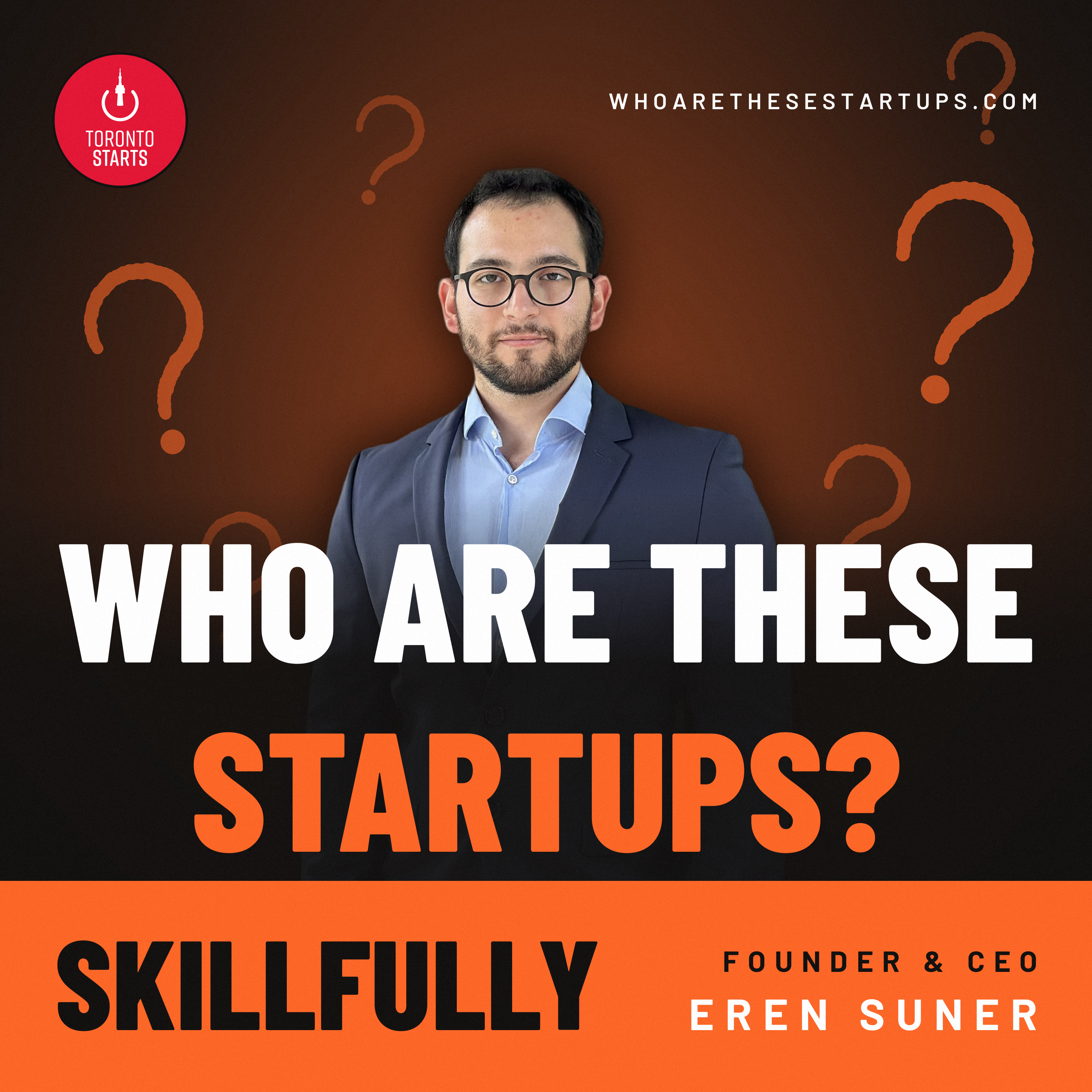
Eren Suner of Skillfully: Turning Expert Methods into Paid AI Agent Skills
Most people who read a great business book never manage to apply it. Eren Suner, founder and CEO of Skillfully, thinks AI agents can fix that. On this episode of Who Are These Startups, Eren explains how Skillfully helps authors turn their methods into agent skills, instructions that let ChatGPT…



Meet Eren Suner
Skillfully
Eren Suner is the founder and CEO of Skillfully, a Toronto company that helps authors and experts turn their methods into agent skills readers use inside ChatGPT and Claude, with subscriptions and feedback on how the skill is used. Before Skillfully, he did AI research for surgical robots and trustworthy AI at the University of Toronto, and worked as a research engineer in Silicon Valley. Skillfully took part in Next 36.
Most people who read a great business book never manage to apply it. Eren Suner, founder and CEO of Skillfully, thinks AI agents can fix that. On this episode of Who Are These Startups, Eren explains how Skillfully helps authors turn their methods into agent skills, instructions that let ChatGPT and Claude do a task the way the expert would, and how authors earn from them and see where readers get stuck.
Eren shares how he went from AI research on surgical robots at U of T to building an AI agent that tried to do a founder's job, and why that company taught him skills are what make the difference. He talks about building AI Rob with Rob Snyder, author of The Power of PULL, and his goal of getting AI Rob to $100K in annual recurring revenue in the next year. He also covers why free open-source skills rarely get maintained, why Skillfully shares revenue with authors instead of charging a monthly fee, and why a skill is something readers use alongside a book, not instead of it.
Plus: his biggest lesson from Next 36 (put sales first), his morning walk with his AI agent on a call, and the one book he says changed how he sells.
In this episode
- What an agent skill is and what Skillfully does
- From surgical robotics research to an AI founder-agent startup to Skillfully
- Building AI Rob with Rob Snyder, and the goal of $100K in annual recurring revenue
- Why paid skills beat free ones for experts
- Revenue share versus a flat fee
- Skills alongside books, and why pasting a book into ChatGPT isn't the same
- Biggest founder lesson: nothing happens until you sell
- Productivity: a morning walk with an AI agent on call
- Book pick: The Power of PULL by Rob Snyder
Links
[0:11] Craig Major: Welcome back to Who Are These Startups? With me today is Eren Suner, founder of Skillfully. Welcome, Eren.
[0:20] Eren Suner: Hey, it's so nice to be on the podcast.
[0:24] Craig Major: It's great to have you. I really want to jump into what it is you do and we'll get to the rest of your story quickly. So what does Skillfully do?
[0:33] Eren Suner: So Skillfully helps authors turn their method into a recurring tech product. And this is called an agent skill. It was a standard released by Anthropic last year. It's a way you can instruct AI agents to do things a in a certain way. And obviously people want to do things the experts way. So skillfully helps experts both write these as well as monetize and receive analytics on these skills.
[1:09] Craig Major: so what is your startup story how did you go from ai research at u of t to publishing paid skills
[1:17] Eren Suner: yeah so um i i was doing a little bit background about my research i was doing uh research about surgical robots so uh an ai for surgical robots basically you could ask these robots uh to do certain movements and then our ai model would do those I had a bunch of stuff like I did some math research before that and some trustworthy AI research. I also worked at Silicon Valley as a research engineer. So I was like really, really research and development kind of person. But then like I always had a knack for doing a startup. I always wanted to do a startup, I think. And a friend of mine reached out to me do a story, but she had no idea what to do it about.
So I guess I viewed it as kind of like a search problem. Like, where does pain exist in the market? So I built an AI agent that would go scour different industries, look at Reddit for people complaining. And then it did find some stuff, but it was so much fun to build it. So I wanted to push it a bit further. Like, can it to do more stuff a founder is supposed to do? And that was my previous company. It didn't work out, but during that company, I learned that skills are what makes the difference. I had to read like startup books and then turn those into skills. And then my agent can do those things correctly, like the experts. Um, obviously me writing the skills wasn't the ideal, um, because if the author could write them, they could add from that so much more information than just the stuff in the book. Um, so that was, that was the idea. That's where it came from, uh, from like practical experience in another company. So
[3:12] Craig Major: There's a saying in the entrepreneurial world that only an entrepreneur will work for work eighty hours a week to avoid working forty. So what drives you um, to be a founder?
[3:27] Eren Suner: Yeah, that's a funny thing. It's definitely been many ATR weeks. What drives me to do this? Even in high school, I had this hidden hobby of collecting books. I really, really liked collecting computer science and math books. And I really wanted to read all of them. But I like, oh, you only have so many hours a day, right? You can't read all of them. So I just wanted to be like really knowledgeable in these domains. I think that's partially what drives me in this project. Like, I want to give AI agents the ability to do things like these experts that I wanted to do. Actually, I wanted to be like those experts, but I can't be like all those experts, right? You can't read all of their books and stuff. So AI gives you a unique way of doing this. I think that's what drives me, like doing things really well.
[4:42] Craig Major: How do you define success?
[4:46] Eren Suner: Personal or in my company?
[4:49] Craig Major: in the company yeah
[4:51] Eren Suner: in the company uh i would say there are there are three hypotheses that i want to validate so first of all when i think about success in a startup uh the goal of a startup in my opinion is to discover a repeatable business model And that happens through testing different hypotheses you have about either who you are selling to, who your partners are, and what's the kind of business model and what you're selling, right? Those are kind of the levers you can change. And the three hypotheses I want to test is first, I have my first customer, Rob Snyder, first partner.
He created a skill and I want to get him to a hundred thousand dollars in annual recurring revenue in the next year. That's my first goal. The second goal is I want to be able to repeatedly acquire new authors. There is no specific number I have in mind, but just something that like if I want to acquire, let's say, fifty authors this month, there's a lever I can change, you know, maybe something like ads, something like that. And then the third one is I see that there are so many really like deeply experienced experts in the world who may have a book out, who might be looking to write about what they're doing, but they don't have reach. So in this industry, reach seems really valuable. So my third is to have a function in my company where i can help those authors build reach build distribution um yeah so those are my three goals that's what success looks like for now
[6:34] Craig Major: so you chose a revenue share for a business model so you revenue share with the authors instead of charging them a fee why did you do that
[6:44] Eren Suner: so i when i think about the business model I think about incentives i want my company to be incentivized the right way so that my partners i so i get paid when my partners get paid in in this kind of industry that i'm in i would call this expert monetization tools there are several different examples like Kajabi Masterclass is another example, I'd say. There's Udemy. And there is now Skillfully. So looking at all these different competitors, not competitors, like they're complimentary because they're not used to make skills, right? Skills are an entirely new thing. But let's say Kajabi. Kajabi charges a flat monthly fee.
And I feel like that's not really aligned. Like even if I'm getting paid, even if my author isn't successful, then that's not going to drive my company to success.
[7:49] Craig Major: So that sounds, yeah, incentives for a win-win scenario where they're not paying you unless they're getting paid is a low risk for them to take.
[8:02] Eren Suner: I would actually, like it's a low risk for them um in terms of money, but making a skill does take some time. So uh there there is some time risk
[8:15] Craig Major: Rob, uh Rob Snyder, or AI Rob, we might get a chance to call up the website later, gave his skill away free first and uh got nothing back. Why did charging for it work better? so
[8:28] Eren Suner: initially so let me give you a little bit of history of skills okay uh skills were released in i think november twenty twenty five uh by anthropic and they were immediately adopted by developers would use these to make sure their AI agents would design better for example or do things their way and people started sharing skills on these developer websites such as github then the, yeah, So skills were mostly shared uh, for free and open source. But as you can imagine, like when you share something for free, it becomes like a lead magnet for people. they don't really maintain it. A survey found that like, seventy-five percent of skills out there in the world either had reckless instructions or malicious instructions in them. So still quality was really low.
So that's a little bit history of the skills. There's now over a million of them shared on open source. But if you imagine an expert, you need to give them something to afford their time, right? Yeah, You can't ask them to make this like elaborate bespoke thing and like not get paid. So it was all an incentive thing in my mind. And then I met Rob and Rob was like a living and breathing case study of he had already shared a skill as a kind of, uh, either. I think he was, he wasn't using it as a lead magnet, but he was just giving it to his consulting clients. It was a sales call review skill.
So something that's very like narrow and people really liked it. But Rob wasn't getting anything back from it. It was just kind of like something to give out to people. And when we met, I mentioned like, oh, I have monetization for skills. You can receive so much analytics on it. And we kind of immediately clicked. It was like, we started working together on that call.
[10:33] Craig Major: do you, like you're talking to authors and people who have a lot of knowledge to give. But I kind of see that what you're building is kind of the book of the future where authors will just publish because people have to read books and they have to consume them to figure out how to use them and then try to apply them where they are, where they want to short circuit that solution and say, why don't we dump the knowledge into something like the skill? I take the time to do that. And then everyone can just start at point C, not at point A.
[11:13] Eren Suner: Yeah, so So you mentioned a couple of things. I think what I've seen from the interviews I've done is people... don't get a skill instead of a book. They get a skill in addition to a book. Like Most of the people who use Rob's skill already have his book, have read his book, and want to implement the ideas in his book immediately. It's not an alternative. This is like a number one thing on their to-do list. And the other thing I wanted to mention is people give books to LLMs. So this is not a recent phenomena. People have been doing it since I think they were released. But what Skills offers is so much more than just the book and the knowledge. Skills offers a trusted and repeatable way of doing a task, like early stage sales, like an expert, like Rob Snyder. So the value comes from the author testing the skill and making sure it works well rather than just giving the knowledge. Just giving the knowledge is many people have already done it. The people I've interviewed, they just take Rob's Substack and the book and put it in an LLM, but it doesn't give them the same results.
[12:42] Craig Major: I guess what I'm saying is that that's what's happening now, but I see us moving toward a future where authors will decide that let's work with someone like you and develop skills instead of authoring, taking the time to author a book. Because that same effort focused in developing the skills of my knowledge, like if someone took a course, they'd walk out, this is how you do a sales call, this is how you do this, this is how you do that. and putting them into skills and then showing people how to use that to me sounds like a much more viable uh, revenue option for these type of people in the future rather than a hard book.
[13:25] Eren Suner: Yeah. And a book sells for what? Twenty, thirty dollars. A skill sells for fifty to one hundred dollars a month. That's the ideal target range I'm going for. Although with Rob, we are kind of early stage. So we are we priced a little bit lower. But yeah, I see the field moving forward at that kind of pricing. And you're definitely correct. Like I think authors are going to move toward making products for AI agents as opposed to just humans. There are a couple of differences between a book and a skill. I like to view a skill as a dynamic thing. Like it tends, It needs to evolve. That's why I have built like these analytics stuff. So people's agents actually give feedback to Rob's skill, and Rob can read them. Like, this is what The agent would say, this is what I tried to apply the skill to, but these were the gaps. That's what confused me.
So I think that change is definitely taking place as we're speaking.
[14:36] Craig Major: What's your biggest learning as a founder?
[14:43] Eren Suner: So before this company, when I was in high school, every summer I would try to start a company. That was my summer project. And it would always end in a failure because I wouldn't be able to sell it to anyone. going through Next 36, my biggest learning was that nothing happens until you sell. Nothing happens until you convince someone. So it needs to be like, it needs to be number one on your to-do list, not after the product and all this other stuff. I think that's my biggest learning. Put sales first.
[15:25] Craig Major: What's your favorite productivity hack?
[15:28] Eren Suner: Hmm. My favorite productivity hack. What I like to do is I like to go on a morning walk with my agent on call, so I it's like having an executive assistant. But it just helps me so much like plan out my day. I I guess I'm not someone who. who does planning and like that kind of executive function things very well. I need a little bit more structure kind of imposed and that's using my AI agents and having a call in the morning while walking works really well.
[16:11] Craig Major: Do you have any tips for founders?
[16:13] Eren Suner: Hmm. Let me think. So actually, the Next 36 applications were open like a month or so ago. And I met a lot of like ambitious founders who are applying to this program. And I did try to give my best advice to them. Take it really seriously. I think this is a problem I see. like take your company really seriously if you don't take your company really seriously other people also will not like you need to to work many hours on it and you need to make decisions that put your company forward so that might mean not having lunch with your friend not doing something fun and instead choosing to work on your company This
[17:07] Craig Major: is a good one for you So what book every founder should read
[17:11] Eren Suner: what's one book every founder should read one book i think like i'm gonna be super biased here and say uh The Power of PULL by Rob Snyder he's my first author but that book did really change how i do sales like before reading that book i thought sales was convincing people. Like my job was to convince people. But with Rob's book, I learned that this is kind of like a search. You are trying to find the right group of people. And I think it changed the destiny of my company, reading that book.
[17:52] Craig Major: So AI Rob is your first product. And the link to that will be in the show notes. Where else can our listeners go and connect with you and find out more?
[18:02] Eren Suner: So there is the Skillfully's own website. You can access it at skillfully.sh. And there you can apply to work with us. Skillfully is an apply only program. And we will be in touch if you go to our website and apply. other than that, you can connect to, sorry, Craig, you can connect with me on LinkedIn or on Twitter. It's Eren Suner, like E-R-E-N, first name. And Suner, like I fix the sun in the morning, S-U-N-E-R, last name. You can connect with me.
[18:42] Craig Major: And I'll make sure those links are in the show notes. And probably if... If you don't mind, a link to your LinkedIn as well are in the show notes so anybody can grab that there.
[18:53] Eren Suner: Sounds perfect.
[18:54] Craig Major: I really appreciate you taking the time out today. Any last thoughts for our listeners?
[19:01] Eren Suner: Not really. It has been a blast. Thank you so much, Craig. It was great talking with you today and have a great weekend or week.
[19:09] Craig Major: You as well. Take care. Bye.